

To mark International Day of Play on 11 June, schools across Cardiff are invited to take part in the Cardiff Play Mission. The mission is part of Cardiff’s wider Child Friendly City work and supports the city’s Play Sufficiency Action Plan.
Wales has a strong national commitment to children’s play. Local authorities are required by Welsh Government to assess and plan for sufficient play opportunities, and the information gathered through this mission will help Cardiff build a clearer picture of play opportunities, barriers and child-friendly spaces across the city.
The Cardiff Play Mission has three simple parts. Schools can choose to take part in one, two or all three.
How schools could take part with pupils
Schools can take part in whichever way works best for their setting. The missions could be explored through an existing pupil voice group, school council, Rights Ambassadors, eco group, wellbeing group or class discussion. They could also be used during form time, circle time, health and wellbeing sessions, humanities or local area learning, outdoor learning, or as a short assembly follow-up activity.
The aim is not to create extra workload or a formal project. A short discussion with pupils is enough. Schools may want to ask pupils what they already notice, know, use or value, then use the forms to share that information.
For Mission 1, pupils could be asked to notice signs during their normal journeys and bring their observations back into school. For Mission 2, pupils could discuss what play opportunities they know about or value on school grounds after 3pm or during the summer holidays. For Mission 3, schools can take part in the Play 31 Challenge in whichever way fits the school day.
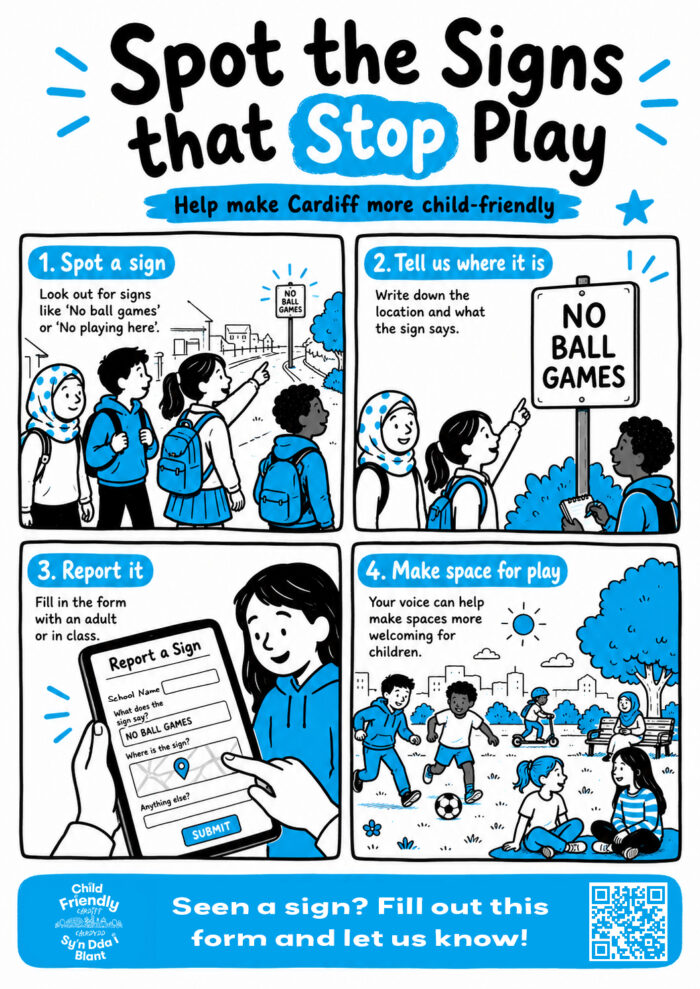
Mission 1: Spot the Signs that Stop Play
Around Cardiff, there are still some old signs that tell children where they cannot play, move or be active. These might include signs such as “No ball games”, “No playing here”, “Keep off the grass”, “No cycling” or “No skateboarding”.
Some of these signs are very old and may no longer be recorded on council systems. They can make places feel less welcoming for children and may stop children enjoying their right to play, relax, move, be active and spend time with friends.
Pupils can help by spotting these signs during their normal journeys, such as on the way to school, on the way home, near parks, near clubs, near places of worship or in other places they visit as part of everyday life.
Pupils should not be asked to go out specially to look for signs or do anything unsafe. They should not enter private land, touch or remove signs, or challenge anyone about a sign. This is about noticing and reporting signs safely.
Schools can submit findings through a short form. Pupils can describe what the sign says, where it is, what kind of place it is in, and how they think it affects children’s play. There is also space for pupils to suggest a more positive message.
Mission 2: Share What’s Already Happening on School Grounds
As part of Cardiff’s Play Sufficiency work, we are trying to build a clearer picture of play opportunities across the city. This includes parks, public spaces, community groups, youth services and school grounds.
Schools are invited to share a short snapshot of any existing play opportunities available on school grounds after 3pm or during the summer holidays. This might include clubs, play schemes, sports, supervised use of outdoor spaces, wraparound provision, or activities delivered by external providers on school grounds.
This is not an audit, inspection or comparison exercise. It is not about asking schools to provide more, and it does not create any new expectation. The aim is simply to understand what already exists, where schools feel able to share it.
Schools may wish to involve pupils in identifying the opportunities they know about, use or value. Staff can then add factual information where useful, such as when provision runs, who delivers it, and whether it is open to all pupils or specific groups.
If a school does not currently have provision, or if provision is limited, that is also useful to understand. It helps build an honest picture of opportunities, barriers and pressures across the city.
Mission 3: Take the Play 31 Challenge
Schools are also invited to take part in the Play 31 Challenge on 11 June, International Day of Play.
The Play 31 Challenge is a UK Children’s Play Policy Forum call to action, delivered in collaboration with the UK and Ireland’s five International Play Association branches. Play Wales is a member of the UK Children’s Play Policy Forum and has shared information about the challenge for schools in Wales.
The challenge encourages schools to give children 31 extra minutes of play during the school day. It is inspired by Article 31 of the UN Convention on the Rights of the Child, which recognises every child’s right to play, rest, leisure and cultural activities. This year’s campaign theme is “Protect play, protect childhood”.
Schools can take part in a way that works for them. This could include extending playtime, supporting playful outdoor learning, creating extra space for free play, or building playful activity into the school day.
Why this matters?
Play is not just a nice extra. It supports children’s health, wellbeing, friendships, confidence, movement, creativity and sense of belonging. It also connects directly to children’s rights, including the right to play, the right to be heard, and the right to be safe.
The Cardiff Play Mission gives schools a simple way to celebrate play, support pupil voice and help Cardiff better understand children’s experiences of play across the city.
The information gathered through the mission will help inform Cardiff’s Play Sufficiency work and support future planning around play opportunities, barriers and child-friendly spaces.
What happens next?
The mission will be open throughout June. Schools can take part in one, two or all three missions, depending on capacity and what works best for their setting.
After the forms close, the information will be reviewed and used to support Cardiff’s Play Sufficiency Action Plan. Where pupils identify signs that may discourage play, these will be mapped and reviewed where possible. Information about play opportunities on school grounds will help build a clearer city-wide picture of existing provision after 3pm and during the summer holidays.
We will aim to share a short update afterwards so schools and pupils can see how their contributions have helped.